Thursday, 30 May 2013

A.R.T.'s Vs. Science

Assisted Reproductive Technologies are an amazing way in which science has given the opportunity for an individual to be able to have children if it were not possible beforehand due to biological issues.

Although with anything relating to new scientific technologies, social change is required for it to be fully accepted (which can take its sweet ass time).

In Peterson's reading about ART's he discusses the initial objection to such technologies due to the fear of the unknown, this fear led to assumptions that the development of the child would be affected if it was conceived un-naturally through IVF, although we know that isn't the case now.

Peterson believes this is due to ART's challenging the normativity of having children through widening the scope of options out their for people.

I found the interrelations between the factors that work to oppress or deny access to the technologies, that Peterson wrote about very interesting, it demonstrates how closely related and joined many institutes are.


The way they function seem to work in a circle like in a catch 22.

I'll jump into the circle at economic factors many ART's are expensive to access, in Australia one round of an IVF treatment can cost into the thousands. This fact already excludes the many who may want to access this technology but simply can't afford to.

Next we arrive at legislation, people who genuinely need IVF or other ART's like same sex couples are denied their right through government legislation which can be seen as breaching the Commonwealth Discrimination act. Some state legislation up until recently required to women to have written consent from her husband to gain access to ART's.

To be able to gain access to ART's the individual needs to prove to a doctor they are unable to conceive on their own due to biological issues.
this website has some fantastic information on legislation in Australia and New Zealand in regards to ARTs
These interellated concepts are very complex and I'm sure I have simplified it too much but I will post a copy of my essay up when it is completed and I will go into the issue in more depth :)

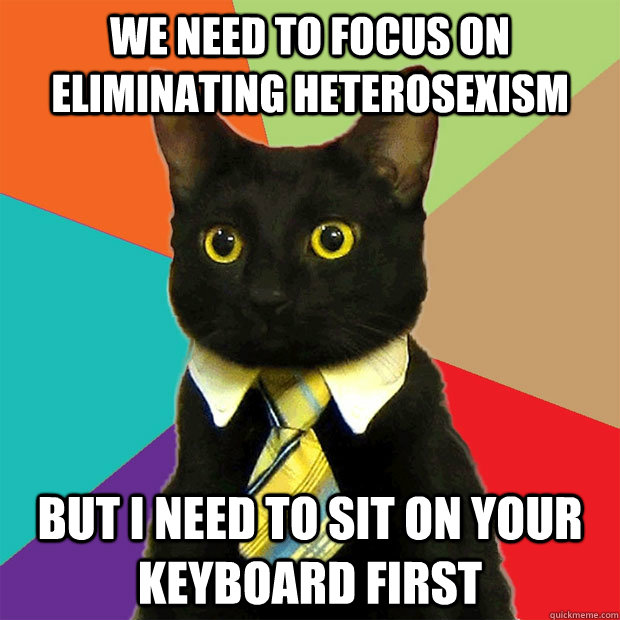
And now because my brain is broken I want to leave you with this


Sexy Sex

The concept of  sexuality, what is sexuality? and how do we define it? and how does it operate as a repressive or dominant machine in society?
 I began my search to define the concept of sexuality through good ol' Google, many of the sites that appeared in my search  struggled to define the term, the AmericanPsychological Association suggest that "Sexuality has three stages: Desire is an interest in being sexual. Excitement is the state of arousal that sexual stimulation causes. And orgasm is sexual pleasure's peaking.". Although the APA have a strong discourse and power in the area , their definition seemed to lack the complexity of the concept for me.

Through the Lecture on sexuality in week 4 we explore the idea of sexuality and the interrelations between the concepts of sexuality, gender and sex, and how power operates within these relationships much like the wedding cake example from Liam Leonard in week 2.

so back to the question earlier how does sexuality operate as a repressive machine within society?
Well my main focus to attempt to answer my question will be through Foucault and his theory on sexuality from his book "the History of Sex" mainly because I found his theory interesting. Foucault believes that sexuality was not used as an identity marker before discursive practices of sexuality were placed upon it, sexuality did not exist as an identity until it was categorised and labelled. Unlike the Repressive theory that many people, previously including me, thought Foucault was using to describe how sexuality operated in society, Foucault's book actually is a critique of this theory. He discusses the idea that there is no true or real sexuality and that sexuality is completely dictated and created by discourse. This to me didn't make much sense at first how can someone who has agency over their body have their sexuality a part of their identity created by the discourses surrounding them without questioning why. Foucault states this is due to the identities created around sexuality in the 18th century, that created mechanisms for the power/knowledge relationship focused on sex and sexuality. These include the hysterization of women and their bodies, the pedagogization of children's sex, a socialization of procreative behaviour and the psychiatrization of perverse pleasure.
The way these identities worked was through micropolitics as Deleuze termed, or as some of you may know the concept of ideological state apparatus. Unlike repressive state apparatuses in which the repressive theory was based, micro politics work through the ideologies of the culture in the society, instead of a behaviour being illegal it may instead be 'frowned upon' or not be appropriate and described as taboo.

As you may already experience in your own life when something is a little bit naughty or taboo it makes it some much more exciting and makes you want to test those lines and boundaries, this is why Foucault called micropolitics a productive mechanism.

I'm going to leave it there but I want to leave you with a video from one of my favourite shows on NatGeo called Taboo.
These desires are classed as taboo due to the fact that it doesn't involve the hetero normative sexuality and I think it is interesting who has the discourse to talk about this taboo.
A blog I read as I was writing this was Foucault's Nostalgia? by John Protevi 


Sunday, 5 May 2013

OH The Hegemony.

When I think about masculinity I automatically think white, muscly, covered in body hair, and I'm sure I'm not the only one. But the reality for most men is they will never be like that, so how does the discourse of masculinity operate within our genders?


To be honest with you I have never really considered the idea that masculinity could be considered as a multiple concept, masculinities and how complicated the idea may be to navigate, I mean how hard is life when you get paid more, have more opportunities and greater privileges than your female counterparts, right? 

Well it seemed uncomplicated to me, but I have also never considered that I am looking at this as a white heterosexual female in western society, This realisation hit me like a tonne of bricks when I began the readings for the week. 

The piece by Dr Audrey Yue discussed the idea of the feminised Chinese male, from the colonised point of view and how Bruce Lee and his films challenged these ideas Western society had. Bruce Lee, as Yue puts it, made way for re-masculization of bodies and as a result Bruce Lee and his films became a symbolic platform where this was possible for feminised bodies of subordinate culture and races. 
"The Year Enter the dragon was released and topped the American charts ........the genre was only popular among black, Hispanic and working class audiences" thus created a subculture ideology of masculinity.

The discussion then turns to the popularity of such films like Rambo, and how a white masculinity broke through into the mainstream culture.  
Yue describes these competing masculine ideologies through the settings the mainstream Rambo represents to colonisation of such lands like China or in the films case Vietnam, where as Bruce Lee is the counternation to the American Rambo.
These ideas got me thinking about the question I had earlier how does masculinity and its discourse operate throughout society. One main idea I kept coming back to is the idea that the reason it operates the way it does is due to the fear of the other, the otherness to white I suppose. 

Which brought me back to my first year subject in gender diversity, where we discussed the idea of "Orientalism" (click here to see interview with Edward Said) in a book by the same named penned by Edward Said in 1978, around the time when Bruce Lee's movies were being released. Said discusses the misrepresentations and ideas that Western society have of the Orient or the East, and how they are used in opposition to the Western culture. These ideas are not based on reality, much like the feminised male Asian bodies and are used to create a discourse and power over the otherness of white. 

The idea of fear as I mentioned earlier as an the fear of opposition or difference to ourselves probably drives Western Society to take the power away from the Orient, therefore taking the need for fear away.  

 This idea of fear can also be related to not only race as above but also sexuality, desire and gender. The fear of being seen as feminine creates the need for mean to reject everything feminine except in a desirable way. Liam Leonard suggested during the lecture that the relationships with parental figures can affect the future identity of a person for example; A female child may desire her mother and then reject the father, or a male child may have the opposite happen causing him to behave in a feminine way. Throughout society there are many ways in which we are praised or punished for behaving gender appropriately, not through a repressive state apparatus, but as an ideological state apparatus.           

Looking back now I still have only covered heterosexual ideals of masculinity, and there are many more masculinities out there not only in the hetero normative world but in the queer spheres and other cultures as well. 

Oh well Maybe another time :)   


Saturday, 23 March 2013

Dive Right In

Just a little something to get us started.


Knowledge is power is something that you sometime hear during your life time, I've heard it before and never really gave it a second thought until last week when it came up in the week 2 lecture and this is where i want to point the focus of this blog.

Although this is a complex topic I'm going to attempt to summarize with out loosing too much information.

In simple terms knowledge allows for a person to gain power over another, we see it manifesting in our day to day life constantly but often pay no attention to it.This theory of the relationship between power and knowledge has been brought forward by influences of the Structuralist theories and is elaborated more in post structuralism through such theorists as Luis Althusser, Judith Butler and Michel Foucault , in which our social and cultural systems can be understood through the relationships between them and a more powerful ideology. The Structuralist standpoint this was focused more on structural linguistics through the work of Ferdinand DeSaussure, where as Foucault and the post structuralist theories saw this as a social construct of power for example patriarchal society. Foucault discusses this theory in relation to sexuality in the week 2 readings, from his book the history of sex. He discusses the issue of power and knowledge leading to repression.


The way this system seems to work in our society is through the praise and punishment which is referred to as heterosexism where heterosexuals gain privileges in order to repress or discriminate the otherness, as Liam Leonard, Director of Gay and Lesbian Health at Latrobe, suggested in the lecture, compulsory heterosexuality. Our gender sexuality and sex is placed in a hierarchy Liam used the examples of his wedding cake model and of Gayle Rubin's 'Charmed circle' (as pictured below) where you can see the inner circle is widely accepted to be 'normal' and the outer limits are often looked at culturally as taboo and wrong.

'
So how did we become so hetero normative in our beliefs? there must have been some advantage for society to believe that hetero sexism is 'normal'. Foucault claims it began in the Victorian Era where sex became unspoken.

there is no doubt that the move towards sex, gender and sexuality being only for procreation benefited the Bourgeois state, and by using the Discourse to repress and remain in power we still see the effects in all state apparatus. 


Obviously i could continue on for hours discussing this topic, I tried to keep it short :)
Until next time. 


Saturday, 9 March 2013

Discovering the waterfront

Where to begin 

Gender vs. Sex what's the difference? I hear you say, well I guess that depends on how far your willing to wade into the water in front of you. 

Everywhere you look this question confronts us, what exactly is the difference between gender and sexuality?  to many people they will say there is no difference they are one and the same and if you have a penis you are a man and if you have a vagina the opposite is so, and who we are is defined by what we are not.
Unfortunately the situation is not so crystal clear once you start going below the surface, the water is muddy and all the lines are blurred. 

This weeks lecture we started to dip our toes into these ideas and theories, into the muddy water and the unknown. So what exactly is the difference between the two terms? well to quote the World Health Organisation or WHO, sex is either male or female whilst gender is classified through masculine and feminine behaviors.  
everyday I see children striving to be their 'gender' boys playing rough with cars and other 'boy' activities and little girls playing with dolls and being art and crafty, but no one has told them specifically this is how to act if you a boy or girl. 

My hopes in the weeks to come I will be able to discuss these ideas more in depth and be a little closer to answering all my questions.......... But chances are that I will have more questions to answer by the end of the semester and at least have more knowledge and discourse in this area of study.


........until next time


Wednesday, 6 March 2013

Introduction


Hi everyone and welcome to my blog. In the coming weeks you'll read my thoughts, my feelings and my ideas about sex.
Now I know what you maybe thinking, and trust me what I'm talking about will be much less R rated than your probably hoping.
The reality is I'm studying Education at La Trobe University and I'm minoring in Gender Studies. I have been told many times that I have chosen a weird combination of subjects, but I find that I couldn't have made a better choice enrolling into gender studies, now seeing how closely these two discourses relate to each other.

I chose this subject because it has always interested me how people construct their gender. For as long as I can remember, I have always questioned and wondered why do boys and girls act the way they do and why do I get treated differently depending on the way I present myself and the activities I involved myself with. 
When I was young I was lucky enough to have parents who let me explore and play around with both of these identities and all of the in betweens with out judgement. 

Many of the questions I had when I was younger are finally getting challenged and explored in depth, and hopefully I can share all I'm discovering with you, the reader, and I hope that you, the reader, will become involved in the conversation and begin questioning what you see happening in the world around you to.